


There are older histories of Samaryn than the ones the Empire allows us to keep. Most of them are incomplete. Some were erased with purpose. What remains are fragments, maps, trade records, clan songs, and the occasional sealed decree that found its way into my archive.
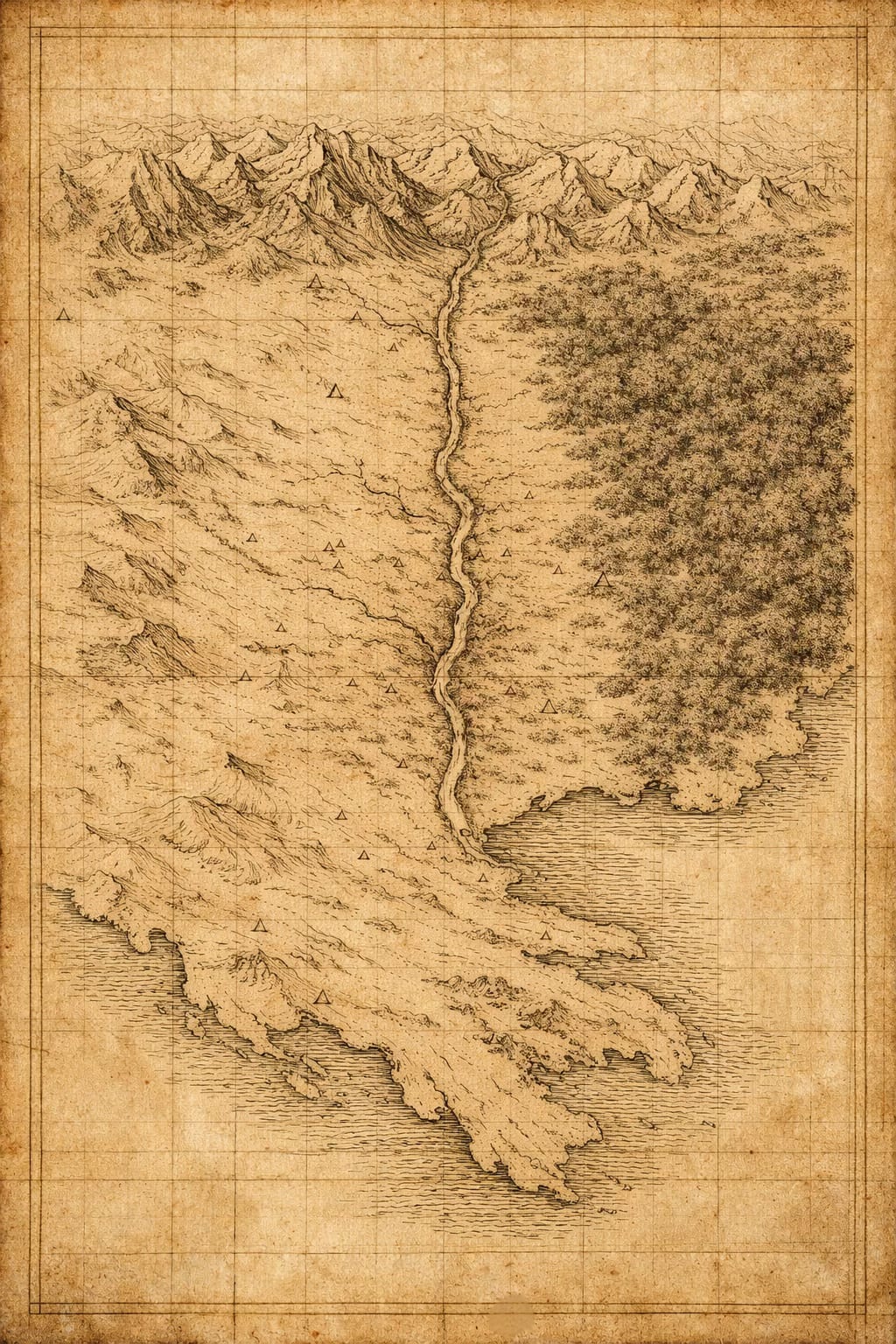
This map was recovered from a bundle of early survey parchments whose origin remains uncertain. The ink, the hand, and the cartographic style do not match any standardized imperial drafts from the early Codified Era, suggesting that it predates the Empire’s formal surveys of the continent. What we see here may be nothing more than a first impression of the landmass drawn by unknown cartographers who had only fragments of knowledge. The coastlines appear hesitant, the interior speculative, and the river system far more confident than the surrounding terrain. It is possible that this was assembled from scattered merchant reports, caravan notes, and river pilots’ recollections rather than from direct exploration. If so, this parchment may represent one of the earliest attempts to imagine Samaryn as a single geographic whole.
The Highlands speak in hush tones of the One.
No chronicle agrees on whether the One was a god, a man mistaken for one, or simply the first to unite scattered tribes into something resembling a people. The matriarchal clans who now rule the Highlands do not openly revere this figure. Yet the older women still lower their voices when the subject arises.
The Empire itself prefers to begin its story later.
It begins with the Codifier.
Centuries ago, a figure now carefully absent from imperial textbooks established the laws that would bind much of Samaryn together. Records from the early Codified Era suggest he consolidated the Southern Peninsula, the Western Drylands, and the Eastern Marches under a common legal framework. Trade routes were formalized. Military garrisons were established. The administrative capital of this new order became Valen Cor.
Why the Codifier later disappeared from official memory is unclear. The laws remain. His name does not.
Beyond Valen Cor lies a continent of uneasy cohesion.
The Highlands remain divided into ancient clans. Their society is matriarchal and fiercely independent. Alliances shift with seasons, marriages, and vendettas. Imperial authority reaches their valleys unevenly. No decree from the capital travels the mountain paths without resistance.
Southward lies the peninsula, where warm harbors feed the sea trade that enriches Valen Cor. Ships from distant coasts unload spices, metals, and unfamiliar tongues. The southern ports are the Empire’s lungs. Without them, Samaryn would suffocate economically.
To the west stretch the Drylands.
The people there still recount the sighting of a comet generations ago. The event shaped their faiths, their markets, and even their migrations. Entire towns measure prosperity by cycles tied to that ancient streak of fire in the sky.
The River Marches in the east tell a different story. Dense forests make the region difficult to govern. Imperial patrols move slowly along the waterways. Refugees and insurgents often arrive from beyond the frontier. Authority exists there, but rarely without negotiation.
And then there is the Mistfold Basin.
Few places in Samaryn promise more wealth. Iron veins lace its southern rim. Trade caravans converge along its approaches. Engineers from Valen Cor already speak of roads and tunnels that may one day turn the basin into the economic engine of the empire for centuries to come.
Samaryn itself is older than any empire that claims it.
Humans have crossed these lands for millennia. Traders from distant coasts, refugees from forgotten wars, clans from colder northern regions, and caravans from lands we barely understand have all left their mark. The tongues spoken in Samaryn carry echoes of those migrations.
Only in the Codified Era has the Empire attempted something more ambitious.
Uniform law.
Standard trade.
Military order.
Economic integration.
A single system imposed upon a land that has never been singular.
Beyond Samaryn’s borders lie powers we have yet to confront. Empires are rumored west of the Drylands. Others are said to exist beyond the Eastern Marches. North of the Mistfold Basin, travellers speak of a land so distant it has become myth.
One day the Empire may turn its attention outward.
But the wiser officials in Valen Cor understand a simpler truth.
Samaryn itself is not yet fully understood, much less fully governed.
— R
Curator, Fragments of Samaryn
